
Description
Geological and Crystalline Structure
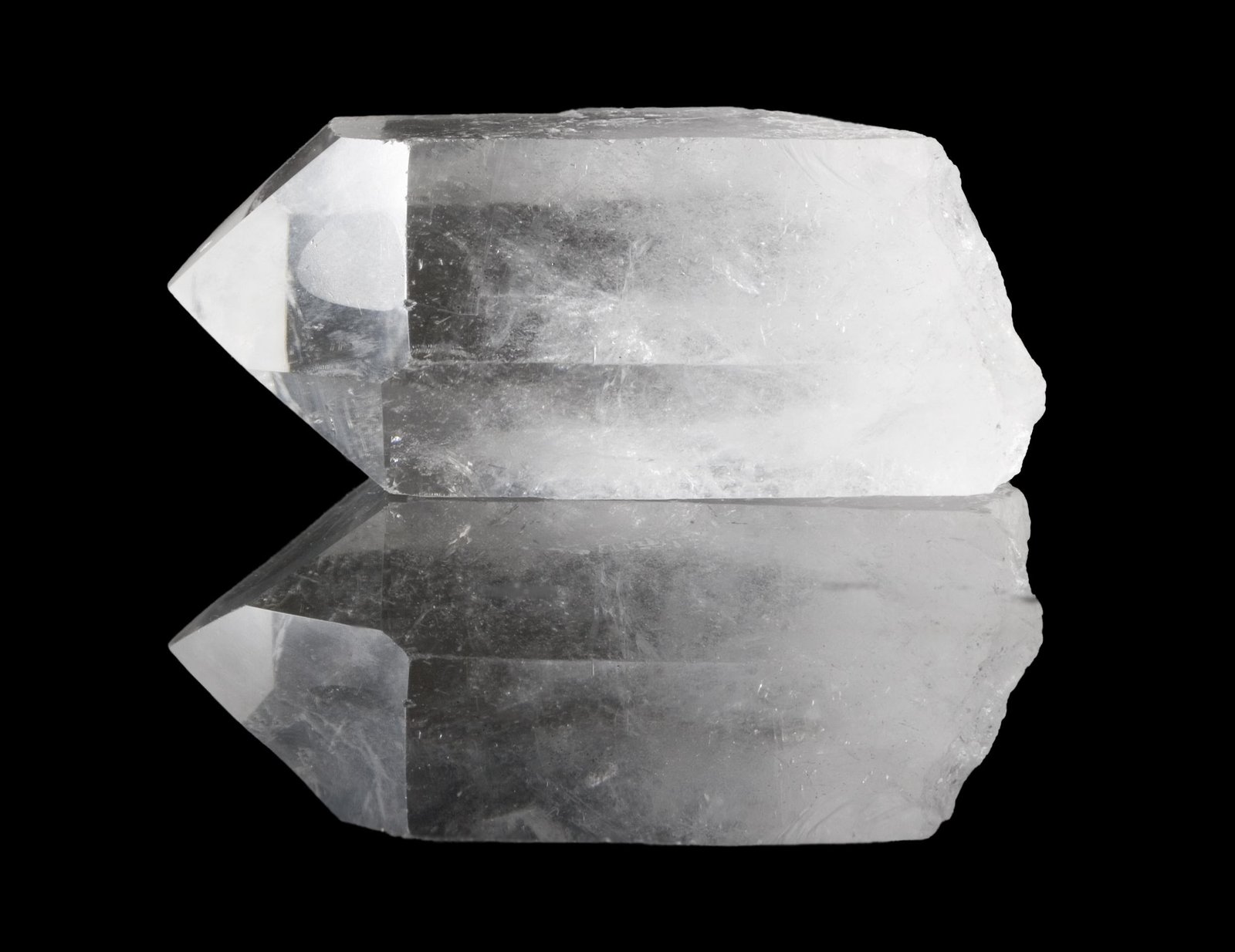
Quartz is the second most abundant mineral in the Earth’s crust. It is a framework silicate mineral, meaning its atoms are linked in a continuous framework of silicon-oxygen tetrahedra. The characteristic point shape arises from its crystallization in the trigonal crystal system (a subset of the hexagonal system).
While an idealized crystal has a six-sided prism capped by a six-sided pyramid at both ends (double-terminated), in nature, crystals are usually attached to the host rock at one end, resulting in a single point or termination. The distinct faces (or facets) on the point meet at precise, constant angles, a fundamental law of crystallography discovered through the study of quartz.
Varieties and Significance
-
Clear Quartz (Rock Crystal) is the pure, colorless, and transparent form. Impurities or inclusions lead to other well-known varieties like:
-
Amethyst (purple, due to iron impurities)
-
Citrine (yellow-to-orange)
-
Smoky Quartz (gray/brown, caused by natural radiation)
-
Rose Quartz (pink)
-
Quartz is highly significant economically due to its piezoelectric properties (generating an electric charge under mechanical stress), which makes it essential in electronics for maintaining a precise frequency, such as in watches and radios.
Metaphysically, Clear Quartz is often called the “Master Healer” or “Stone of Power.” It is believed to amplify energy, thought, and the effect of other crystals. It is also used in meditation to clarify intentions and harmonize the body’s energy centers.

Reviews
There are no reviews yet.